Your Gut Bacteria May Be Rewriting Your Calorie Count: The Fiber Effect
Your calorie app is an estimate, not a verdict. New controlled research shows gut bacteria can shift absorption by roughly 116 calories a day, and fiber is the lever you control.
Your Gut Bacteria May Be Rewriting Your Calorie Count: The Fiber Effect
A controlled feeding study suggests a high fiber diet can cut the calories you absorb by roughly 116 per day. Fiber feeds gut bacteria that produce short-chain fatty acids, slow digestion, and increase energy lost in stool, meaning food labels and calorie apps are estimates rather than fixed truths.
If you have ever eaten exactly the number of calories an app told you to eat and watched the scale refuse to cooperate, you already understand the problem. Nutrition math looks precise on a screen. In the human body, it is a negotiation between your enzymes, your transit time, and roughly 38 trillion microbes that would very much like a say in the outcome.
That negotiation is the subject of a new controlled study covered by ScienceDaily, and its headline number is refreshingly concrete: about 116 fewer calories absorbed per day on a high fiber diet. Over a year, that is more than 42,000 calories, or roughly 5 to 6 kilograms of body fat, without a single skipped meal. The mechanism is not willpower. It is microbiology.
What makes this research genuinely useful is not the headline figure on its own, but what it reveals about calorie tracking accuracy in general. Every label, database, and app is built on averages that were never measured on your body. Fortunately, tracking real nutrition, including macros, micronutrients, and polyphenols, no longer requires burdensome manual lookups or endless barcode scanning. More on that below.
Why Your Calorie Count Is an Estimate in Disguise
The numbers on food packages trace back to Wilbur Olin Atwater, a Wesleyan chemist working in the 1890s. His system assigned fixed energy values to macronutrients: 4 kilocalories per gram of protein, 4 per gram of carbohydrate, 9 per gram of fat. Those Atwater factors, refined a century ago using a small group of men in a respiration chamber, are still the basis of federal labeling rules today.
The system has two well documented cracks.
First, labels are permitted to be wrong by a lot. US Food and Drug Administration labeling rules allow most nutrient values, including calories, to deviate by up to 20 percent from the measured content. A 300 calorie snack bar is legally permitted to be 360 calories or 240 calories. Two products carrying identical numbers can differ meaningfully in reality.
Second, absorption is not constant. The Atwater system assumes near total digestibility. That assumption fails for nuts, seeds, whole grains, and legumes, where intact cell walls physically trap fat and protein before the body can reach them. A USDA Agricultural Research Service study led by Janet Novotny found that whole almonds delivered about 20 percent fewer calories than labels stated, because a portion of the fat stayed locked inside plant cell walls and exited in stool. Similar effects have been documented for pistachios, cashews, and walnuts.
In other words, calorie tracking accuracy has always been approximate. The new fiber research explains one more reason why, and it points to a variable you can actually influence.
What the Controlled Study Actually Found
The 2026 trial compared two controlled diets with identical measured energy content but sharply different fiber levels. Because participants lived on site and ate only what researchers weighed and served, the notoriously unreliable business of self reported food intake was removed from the equation. Researchers tracked stool output, measured residual energy in excreted matter, and sequenced the gut microbiome before and after each diet block.
The result: participants on the high fiber diet excreted measurably more energy and absorbed roughly 116 fewer calories per day. That is a shift of about 4 to 5 percent of a typical 2,400 calorie intake. The researchers linked the difference to bacterial shifts that changed how thoroughly fiber, fat, and protein were broken down before absorption.
On any given day, 116 calories is one tablespoon of olive oil. Over a decade, it is the difference between a body that holds steady and one that slowly gains. Small shifts in absorption compound because they repeat every single day.
It is worth naming the limits. Controlled feeding studies are short, usually involving a few dozen participants, and the 116 calorie figure is an average. Some people in the study likely absorbed far less; some absorbed slightly more. Your baseline microbiome, your transit time, and even your gut anatomy all influence where you land.
How Fiber Changes the Math of Digestion
The fiber effect operates through at least four overlapping mechanisms, each documented in peer reviewed research.
1. Physical trapping and viscosity. Viscous fibers such as beta glucan from oats, psyllium husk, and pectin from fruit form gels in the gut. These gels slow gastric emptying, blunt the rate at which enzymes contact starch and fat, and physically entangle nutrients so that some pass through unabsorbed. This is the same cell wall trapping mechanism behind the almond findings, scaled up across the whole diet.
2. Fermentation into short chain fatty acids. Colonic bacteria ferment fiber into acetate, propionate, and butyrate. Butyrate is the primary fuel for colon cells. Propionate travels to the liver and influences gluconeogenesis. In a landmark 2011 study in the American Journal of Clinical Nutrition, researchers including Jumpertz and colleagues at the National Institutes of Health showed that changes in gut bacterial composition tracked with how much energy participants extracted from identical meals.
3. Satiety hormone signaling. Short chain fatty acids bind to free fatty acid receptors FFAR2 and FFAR3 on enteroendocrine cells, triggering release of GLP-1 and peptide YY. Both are satiety hormones that slow gastric emptying and reduce appetite. This is partly why fiber rich meals leave you full longer at the same calorie load, and it is the same hormonal pathway targeted by modern GLP-1 medications.
4. Increased fecal energy loss. More fiber means more bulk, faster transit in some cases, and more residual energy leaving the body. The controlled study measured exactly this.
There is a counterpoint worth holding: not all microbiomes are equal. Work from the Washington University lab of Jeffrey Gordon and later human studies showed that some bacterial communities are more efficient at harvesting energy from food than others. Two people can eat the same plate and absorb different amounts.
Not All Fiber Pulls the Same Lever
Fiber is not one compound. It is a family, and different types behave differently in the gut.
- Viscous, fermentable fibers (oat beta glucan, psyllium, pectin, barley, legumes) offer the strongest metabolic effects on satiety, cholesterol, and glucose response.
- Resistant starch (cooked and cooled potatoes and rice, green bananas, lentils) escapes small intestine digestion and ferments into butyrate, making it one of the most potent butyrate producers in the diet.
- Insoluble fibers (wheat bran, cellulose, vegetable skins) mostly add bulk and speed transit. Valuable for regularity, less dramatic for calorie absorption.
- Diversity matters as much as quantity. Data from the American Gut Project found that people eating 30 or more different plant species per week had more diverse microbiomes than those eating 10 or fewer, regardless of total fiber grams.
The baseline is bleak: US adults average roughly 15 grams of fiber daily, while the Dietary Guidelines for Americans and Harvard T.H. Chan School of Public Health recommend 25 to 38 grams, or about 14 grams per 1,000 calories. A 2019 Lancet meta analysis of 185 prospective studies by Reynolds and colleagues found that the largest reductions in all cause mortality occurred between 25 and 29 grams per day, with benefits continuing upward.
Does Eating More Fiber Mean Fewer Calories and Less Hunger?
Yes, and the hunger piece is arguably the more practical win. Fiber adds volume and water to meals, slows gastric emptying, and triggers GLP-1 and PYY release. A 2019 trial in Cell Metabolism by Kevin Hall and colleagues at the NIH found that people eating ultra processed diets consumed about 500 extra calories per day compared with a matched unprocessed diet, despite rating both equally pleasant. Fiber density is one of the clearest differences between those two plates.
One caution: do not jump from 15 to 40 grams overnight. Increase gradually over two to four weeks, drink adequate water, and let your microbiome adapt. Rapid fiber loading can cause bloating and gas, particularly with highly fermentable fibers. People with irritable bowel syndrome or a history of bowel obstruction should work with a clinician.
Practical Fiber Swaps That Support Metabolic Health
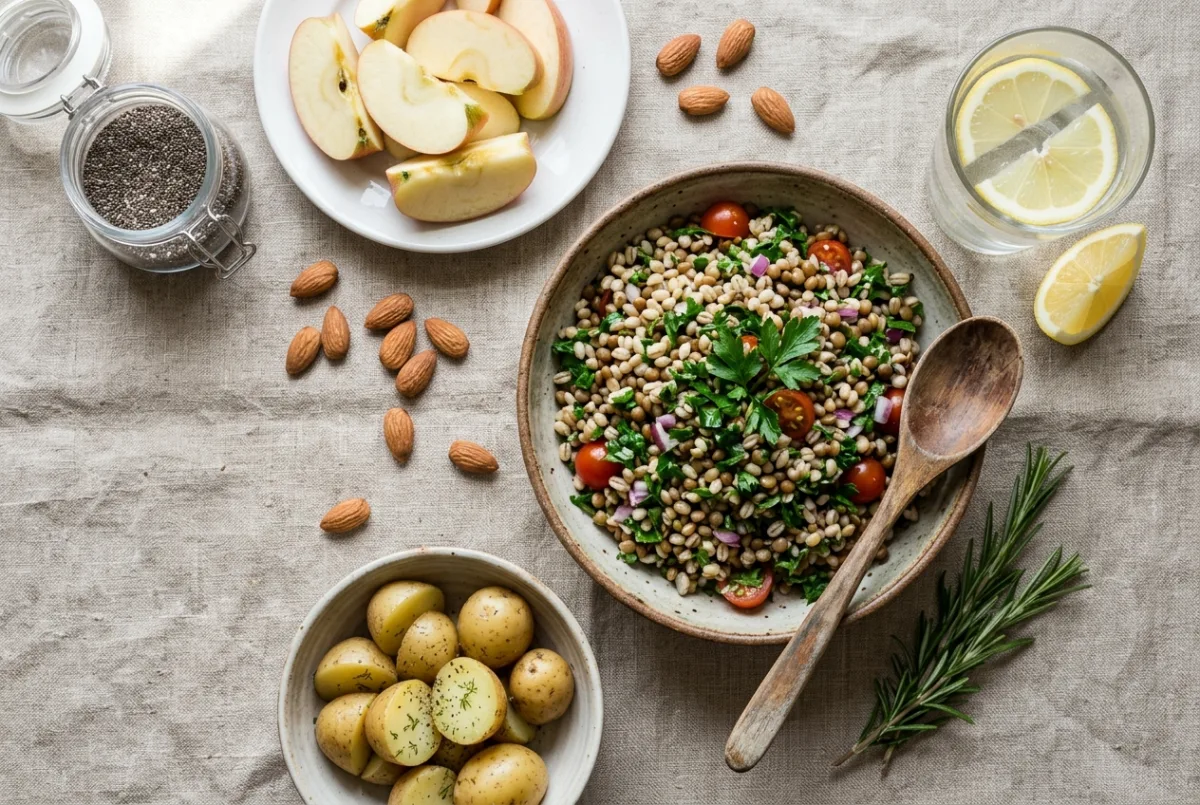
- Swap white rice for barley or farro. One cup of cooked barley delivers about 6 grams of fiber versus under 1 gram for white rice.
- Add two tablespoons of chia or ground flax to breakfast. That is roughly 8 grams of fiber and a strong source of viscous, fermentable soluble fiber.
- Choose psyllium husk before dinner. Five grams in water 30 minutes before your largest meal blunts appetite and glucose spikes; it has the strongest clinical evidence of any isolated fiber supplement.
- Cool your starches. Cook potatoes, rice, or pasta, refrigerate overnight, and reheat gently. Cooling converts digestible starch into resistant starch.
- Keep the skins on. Apple, potato, and cucumber skins carry fiber and polyphenols that the flesh lacks.
- Snack on whole nuts, not nut butter. Intact cell walls mean fewer absorbed calories, per the USDA almond research.
- Build toward 30 plants a week. Herbs, seeds, beans, and berries all count toward diversity.
Here is where tracking gets tricky. Adding chia, psyllium, barley, and skins to your day changes your fiber, protein, fat, and micronutrient totals in ways that generic food databases handle poorly. That is precisely the problem VoxFood was built to solve. Instead of typing entries into a search bar, you simply describe your plate out loud, for example "two scrambled eggs with spinach, olive oil, and a tablespoon of chia seeds," and the app breaks down the nutrients instantly. It also captures the details that labels ignore, like polyphenols and micronutrients, which matter for metabolic health.
Once your logging is effortless, patterns emerge. That is where Coach Rudy, VoxFood's AI nutrition assistant, comes in. Coach Rudy monitors your dietary patterns over weeks, flags where your fiber intake stalls, spots the days you under eat protein, and offers specific, actionable guidance rather than generic advice. Because the calorie numbers on any app are estimates, trends matter more than single day precision, and trend analysis is exactly what an AI assistant does well.
Track Your Nutrition With Your Voice in Seconds
No more tedious barcode scanning or search queries. Simply tell VoxFood what you ate, and Coach Rudy calculates your calories, macros, and micronutrients in real time.
The Takeaway: Track Trends, Not Decimals
The 116 calorie finding should not send you hunting for a perfect fiber number. It should recalibrate how you read every calorie figure you encounter. Labels are useful approximations built on a 19th century model. Your gut bacteria are a live variable. The lever you control is what you put on the plate, and fiber rich whole foods consistently tilt the math in your favor while keeping you fuller.
Start with one swap this week: barley instead of white rice, chia in your oats, psyllium before dinner. Then measure what actually happens, because the trends in your own data will tell you far more than any label ever could. Ready to begin logging today? Open VoxFood, describe your next meal out loud, and let Coach Rudy handle the numbers.
Frequently Asked Questions
Does a high fiber diet really reduce the calories I absorb?
Yes, modestly. The 2026 controlled feeding study estimated roughly 116 fewer calories absorbed per day on a high fiber diet, about 4 to 5 percent of a typical intake. The effect comes from viscous fiber slowing digestion, intact plant cell walls trapping nutrients, and increased energy excreted in stool. Individual results vary widely based on your microbiome and transit time.
Why are calorie counts on food labels not exact?
Labels rely on Atwater factors developed in the 1890s, which assume near complete digestion. US Food and Drug Administration rules also allow up to 20 percent deviation on most nutrient values. Real world absorption differs by food form, processing, and individual gut physiology. USDA research found whole almonds delivered about 20 percent fewer calories than labels stated.
How much fiber should I eat daily for metabolic health?
The Dietary Guidelines for Americans recommend about 14 grams per 1,000 calories, which works out to 25 to 38 grams daily for most adults. A 2019 Lancet meta analysis found the steepest reductions in mortality between 25 and 29 grams per day. Most US adults eat only about 15 grams, so gradual increases are the practical starting point.
Can gut bacteria make me absorb more calories from the same meal?
Yes. Research from Washington University and NIH feeding studies shows that some bacterial communities are more efficient at harvesting energy from food. Two people can eat an identical meal and absorb different amounts. This is one reason calorie tracking is best treated as a directional guide rather than a precise ledger.